Islamabad’s real estate map is quietly being redrawn along the airport–motorway corridor, and the area around Thalian Interchange is emerging as one of its most influential growth belts. Within this zone, Naval Anchorage Phase 2 has positioned itself not just as another housing scheme, but as a structured, master‑planned community plugged directly into this new urban spine.
Rather than asking only “where is the society located?”, serious buyers and investors are now asking a more strategic question: how does this location connect to jobs, infrastructure, and future city expansion over the next decade? This guide takes a deeper look at the nearby areas, access routes, and infrastructure around Naval Anchorage Phase 2—and what that means for long‑term value.
Airport–motorway corridor: Islamabad’s new growth axis
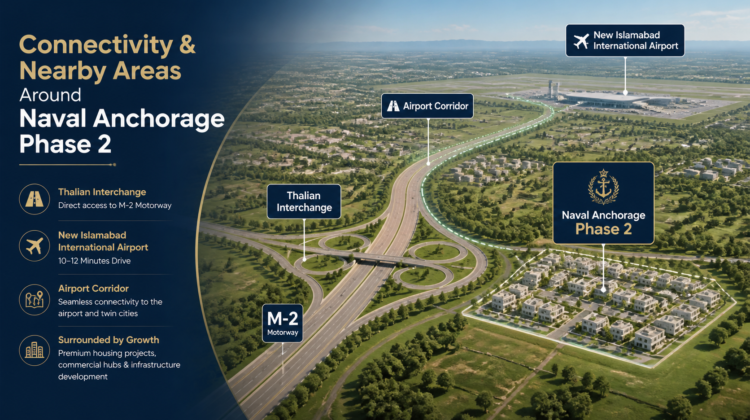
For years, Islamabad’s premium housing narrative revolved around the Islamabad Expressway and the GT Road belt. That gravity is shifting towards the M‑2 Motorway, the New Islamabad International Airport, and the emerging Rawalpindi Ring Road. Thalian Interchange now acts as a critical hinge between these pieces of infrastructure, linking motorway traffic, airport access, and future ring‑road movement.
Government approval of a multi‑billion‑rupee expansion of Thalian Interchange underscores how central this node has become to future traffic and freight flows in the twin cities. Real estate projects that sit within this infrastructure triangle tend to benefit from improved connectivity, rising development activity, and greater visibility among both end‑users and investors.
How Naval Anchorage Phase 2 fits into this corridor
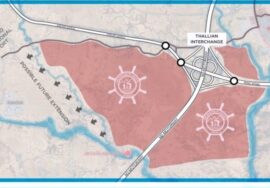
Naval Anchorage Phase 2 sits just off Thalian Interchange on the M‑2 Motorway, effectively anchoring itself inside this airport–motorway–ring road triangle rather than on the city’s older axes. From here, residents gain signal‑free access to the M‑2, direct connectivity to the New Islamabad International Airport, and multiple routes into both Islamabad and Rawalpindi.
Your main site already positions the project as a premium gated community developed by the Pakistan Navy Welfare Trust, with location benefits that include 5–8 minutes’ access to the airport and roughly 25–30 minutes to Islamabad’s core commercial zones such as Zero Point and Blue Area. That places Naval Anchorage Phase 2 in a sweet spot: close enough for daily commuting, but far enough from the flight path and inner‑city congestion to retain a quieter, suburban character.
Nearby housing societies and emerging urban clusters
One of the strongest indicators of an area’s future viability is the quality and scale of projects developing around it. The Thalian belt is no longer an isolated pocket; it is becoming a cluster of large‑scale residential schemes and commercial projects.
Nearby and competing projects that share this broader corridor include developments such as Faisal Town Phase 2, Blue World City, various CBR Town extensions, and other societies positioned around Thalian and the airport approach. This concentration of activity is important for Naval Anchorage Phase 2: it signals that the surrounding land is being transformed into a multi‑project urban zone rather than a single, disconnected scheme.
Over time, such clustering tends to attract private schools, clinics, retail strips, and small business hubs that serve multiple societies at once—improving livability and supporting both rental and resale demand. In that context, Naval Anchorage Phase 2’s disciplined master planning and PNWT backing become important differentiators in a landscape where not all projects are equally structured or regulated.
Access routes and real‑world commute times
For everyday users, connectivity is ultimately judged in minutes, not on marketing maps. Based on the project’s motorway‑side placement and time benchmarks already published on your main page, a typical resident can expect the following broad commute ranges under normal traffic conditions:
- New Islamabad International Airport: roughly 5–8 minutes via Thalian approach roads
- Islamabad city centre (Zero Point / Blue Area): about 25–30 minutes using the motorway corridor and city links
- Rawalpindi Saddar / city centre: around 20–30 minutes, depending on the chosen route and traffic conditions
- Adjacent development zones such as Capital Smart City, Blue World City and other motorway‑side schemes: approximately 15–25 minutes within the wider belt
These are not inner‑city distances—they reflect a peri‑urban, motorway‑linked living model that many commuters actually prefer, especially those who split their time between Islamabad, Rawalpindi and nearby industrial or logistics nodes. As Thalian Interchange is upgraded and ring‑road segments come online, the expectation is that cross‑city journeys will become more predictable and less dependent on older, congested routes.
Infrastructure projects reshaping the Thalian belt
Real estate performance in this zone is closely tied to a handful of infrastructure projects that extend beyond any one society’s boundaries. Among the most consequential:
- Thalian Interchange expansion: Recently cleared for a multi‑billion‑rupee upgrade, the interchange is set to handle higher traffic volumes and provide smoother links to the motorway and ring‑road network. For residents and businesses near Naval Anchorage Phase 2, this should translate into more efficient ingress and egress over time.
- Rawalpindi Ring Road connectivity: As ring‑road segments progress, projects around Thalian are likely to enjoy more direct east–west connectivity, reducing dependency on existing inner‑city bottlenecks.
- Airport‑driven commercial activity: Proximity to the airport inevitably attracts warehousing, logistics, hospitality, and service‑sector businesses within the wider corridor, increasing daytime population and local employment opportunities.
These external projects are important because they support Naval Anchorage Phase 2’s promise of long‑term accessibility without relying solely on internal road networks. When combined with the society’s own 200‑foot Grand Boulevard, wide internal streets, and signal‑free internal traffic planning, the result is a multi‑layered connectivity profile: strong inside the gate and increasingly robust outside it.
Nearby areas: from villages and streams to future urban fabric
The landscape around Thalian today is a mix of traditional villages, open tracts, and new housing schemes, stitched together by the motorway and airport approaches. Naval Anchorage Phase 2 benefits from this transitional character: it is close enough to existing settlements to avoid feeling isolated, yet still surrounded by enough open space to preserve views, airflow, and a less congested skyline.
Your main site already highlights natural streams, green pockets, and open landscapes in the wider zone, which align with NESPAK’s “eco‑luxury” planning philosophy inside the society itself. Around 25–30 per cent of the internal land area is earmarked for parks, green belts and recreational spaces, making the project’s internal environment more resilient and visually distinct from many higher‑density private schemes nearby.
Connectivity and long‑term value: why the corridor matters
From an investor’s perspective, early‑stage pricing, developer credibility, and future connectivity upgrades are the three pillars that typically drive long‑term performance. Naval Anchorage Phase 2 checks all three boxes: it is backed by the Pakistan Navy Welfare Trust, sits on a large 15,000‑kanal master plan, and is located at an interchange that is receiving targeted public‑sector investment.
External market write‑ups highlight that the project currently offers plots from 5 Marla up to 2 Kanal with instalment-based payment options, at rates that still reflect an early‑to mid‑launch stage compared with more mature inner‑city schemes. If infrastructure around Thalian and the ring road continues to progress as planned, today’s connectivity discount could turn into tomorrow’s accessibility premium—particularly for buyers who lock in plots before the full impact of these projects is priced in.
Who is this location best suited for?
Not every buyer has the same definition of “prime location.” The airport–motorway corridor around Naval Anchorage Phase 2 is particularly attractive for:
- Professionals who commute across the twin cities: People whose work takes them alternately to Islamabad, Rawalpindi and the airport zone benefit from quick motorway access and multiple route options.
- Aviation, logistics and hospitality workers: Those employed in or around the airport and associated businesses can reduce commute times significantly while still living in a fully gated, master‑planned community rather than in ad‑hoc settlements.
- Overseas Pakistanis and frequent flyers: For buyers who visit Pakistan several times a year, the combination of a reputable developer, secure gated environment and 5–8 minute airport access is a practical advantage, not just a marketing line.
- Long‑term investors seeking corridor exposure: Investors who believe in the airport–ring road growth story may prefer to hold land in a scheme that is both institutionally backed and structurally integrated into that corridor.
Part of a wider naval housing ecosystem
Naval Anchorage Phase 2 is not a standalone experiment; it is part of a broader portfolio of Pakistan Navy‑backed housing initiatives across the country, including Naval Anchorage Gwadar, Navy Housing Society Karachi, Pakistan Naval Farms and the established Naval Anchorage Phase I in Islamabad. This track record matters when assessing long‑term governance, maintenance standards and community stability.
Within Phase 2 itself, NESPAK’s master plan—with its 200‑foot Grand Boulevard, underground utilities, gravity‑based sewerage, and provision for institutions like Bahria College and a dedicated medical city—indicates that the project’s internal fabric has been designed to match the strategic importance of its external location. In other words, the surrounding corridor provides the connectivity, while the society’s internal planning provides the day‑to‑day livability that ultimately sustains value.